![]() |
|||||
|
|||||
| Avalanche Downhill Racing, Inc. was formed in 1998 by the owners of C Cycle Suspension and WTE Racing to provide the industry with a high performance front suspension capable of meeting the demands of extreme down hill racing. The performance goal was to design the front suspension with the latest features of motocross technology, while maintaining down hill racing requirements.
Craig Seekins, owner of C Cycle Suspension, provides 16 years of motocross suspension tuning and 19 years of mechanical design engineering experience to Avalanche. Eric Wold, of WTE Racing, provides Avalanche with the insights and contacts of a NORBA expert racer, as well as 13 years of top quality CNC machining experience. Riders like Lars Tribus,"Pistol" Pete Loncarevich, Adrian Cortina, John Moore, Fred Bassett and many more have provided valuable input during the development of Avalanche forks. Today, Avalanche is committed to providing limited production "Works Forks" for the most demanding downhill rider. Each fork is custom set-up for the individual needs of the rider. Our dedication to the sport will ensure the highest quality and performance, guaranteed. |
Lars Tribus
|
Avalanche Downhill Racing is not trying to slay Goliath, the company simply wants to slip past the giant and enter his kingdom. Big companies dominate the bicycle parts manufacturing industry and small start-ups enter at their peril. "We don't want to compete with Rock Shox and Manitou, we want to build a niche," said Eric Wold of Danielson, co-owner of Avalanche Downhill Racing, a young company tucked in the northeast corner of Connecticut that recently began making high-end forks and shocks for downhill mountain bikes.
Wold, of Wold Tool Engineering in Moosup, Conn., teamed up with Craig Seekins, of C Cycle Suspension in Colchester, Conn., about three years ago to build a long-travel, triple-clamp fork for mountain bikes that is similar to those used in motocross. The skills of each man complemented the other. Wold was a mountain biker and Seekins was a former motocross racer. Wold had years of machining experience at his family's tool and die shop, and Seekins was a mechanical engineer servicing motocross suspension systems and building upgraded customized parts.
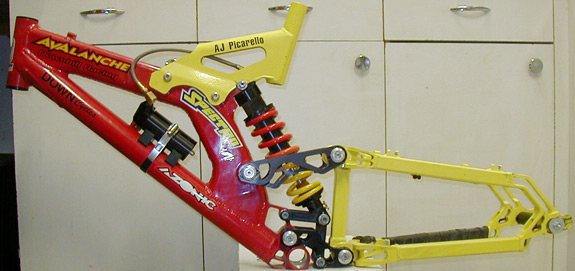
They tested their prototype fork at races during the 1998 season, built a rear shock before the end of the next year, and this season sent out a nine-person team to race on their "works bike." The Avalanche team, using a Cortina DH Extreme-8 frame with Avalanche's MTN-8 fork and MTN-3 rear shock, has reached the podium at least 20 times this season.
The company hopes to capitalize on the success of the team and the exposure it has provided.
"There's a lot of talk about Avalanche at the races," said Ken White of Sutton, a member of the Avalanche racing team. "It's getting a lot of attention. You have to consistently get to the podium and we've proven we can get there."
After years of development and investment, Wold and Seekins believe Avalanche has laid the groundwork for future sales. They say their fork and rear shock offer long-travel suspension and provide a greater range of fine-tuning and customization than others on the market. And they back it with a two-year warranty.
"We wanted to have the team out there so people could see and try out our product," Wold said. "You can build the best product in the world but it takes time for people to have confidence. We're getting there."
Wold began mountain biking about eight years ago when a friend who had an extra bike persistently asked him to give it a try. He began pedaling on trails, but within a year or two became addicted to the thrill of racing downhill.Wold said he and a group of friends would travel to northern New England to test gravity. The riders would take the chairlift to the top of Killington in Vermont and race down the mountain.
"They called it 'going to bomb the mountain,' " said White, who joined the group of mountain bikers. Wold and his friends used rigid bikes when they began the downhill rides. Front suspension forks came along and then full suspension bikes. However, most of the full suspension bikes on the market in the early 1990s were designed for cross-country riding, which is off-road biking up and down hills. The term free riding, which is taking a chairlift up a mountain and riding downhill, had hardly been uttered, and downhill racing was still in its infancy. During those rides in the early '90s, White said, Wold was always pointing out the need for more suspension and saying the bicycle manufacturers should put motocross forks on mountain bikes. "As time went by the bikes got better, but they lagged behind what we needed," Wold said.
Wold said it was about 1995 when he started tinkering. He machined parts at the shop and for a couple of years worked on building the fork he believed was needed for downhill riding. Friends at a local motorcycle shop encouraged Wold to take the fork to Seekins at C Cycle.
"I was very impressed with the quality of the workmanship. It was incredible," said Seekins, who has a degree in mechanical engineering. However, the level of machine work was not matched by its design and engineering, so that model was scrapped. The two collaborated and built their first fork during the winter of 1997. It was a triple-clamp fork that provided 8 inches of suspension. Seekins, whose father had a motorcycle repair shop when he was a kid, designed the new fork based on motocross suspension systems.
After a long search, Avalanche found a mountain bike frame able to accommodate their prototype eight-inch-travel fork. Wold said most suspension systems at the time offered about four or five inches of travel, a few had about six inches, but only an Intense downhill frame could handle their fork.They made two forks for the 1998 season, Wold raced with one and the other was given to different people to try out and provide feedback.
The next winter they made a few minor adjustments and did a small production run of less than a dozen forks.
Avalanche assembled a racing team of three for the 1999 season. In 1999, Seekins and Wold decided to build a rear shock. They completed a prototype rear shock in September, just in time for the Interbike show, an annual trade exhibit for bicycle and parts manufacturers, in Las Vegas. There was some interest in the Avalanche products by frame makers at the show, but Wold and Seekins knew they had to prove their new rear shock at the races. So Avalanche made a larger production run, assembled a racing team of nine members, and outfitted the racers with their "works bikes" for this season.
The achievements of the Avalanche team, which also includes Jay Barrows of Danielson, has provided the Avalanche with exposure for the fork and rear shock, which the company hopes to push next month at the annual Interbike show.
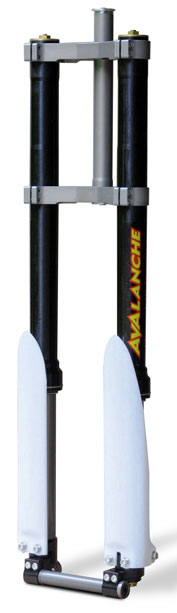
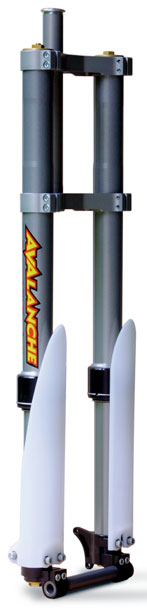
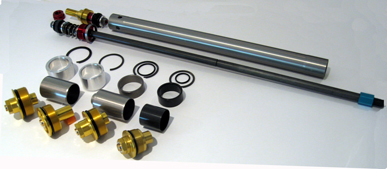
The front fork has an 8-inch-travel coil spring controlled by an oil bath recirculating cartridge system. Each has individual compression and rebound clickers, with a range of more than 20 clicks. An oil lock chamber is used to resist bottoming. The compression and rebound valving is customized for each rider. The retail cost is about $3,000.
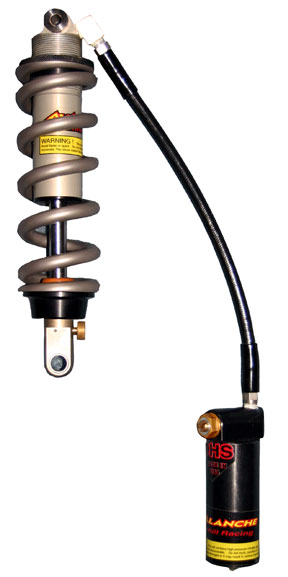
The rear shock is fully adjustable with three inches of stroke. It has individual high and low speed compression and rebound damping. The shock provides nine inches of travel on the Avalanche works bike. The rear shock retails for about $700.
Downhill bikes are usually sold as a frame and rear shock, allowing consumers to install their own forks and other components. Avalanche is hoping to interest small- and medium-size frame makers to consider purchasing their shock to mount as standard equipment. Wold said four companies have already expressed interest in their products, one will be showing its frame with an Avalanche fork and rear shock at the show next month. "We're not trying to sell millions, we're trying to sell hundreds," Seekins said.